When Origin Stops Being Proof
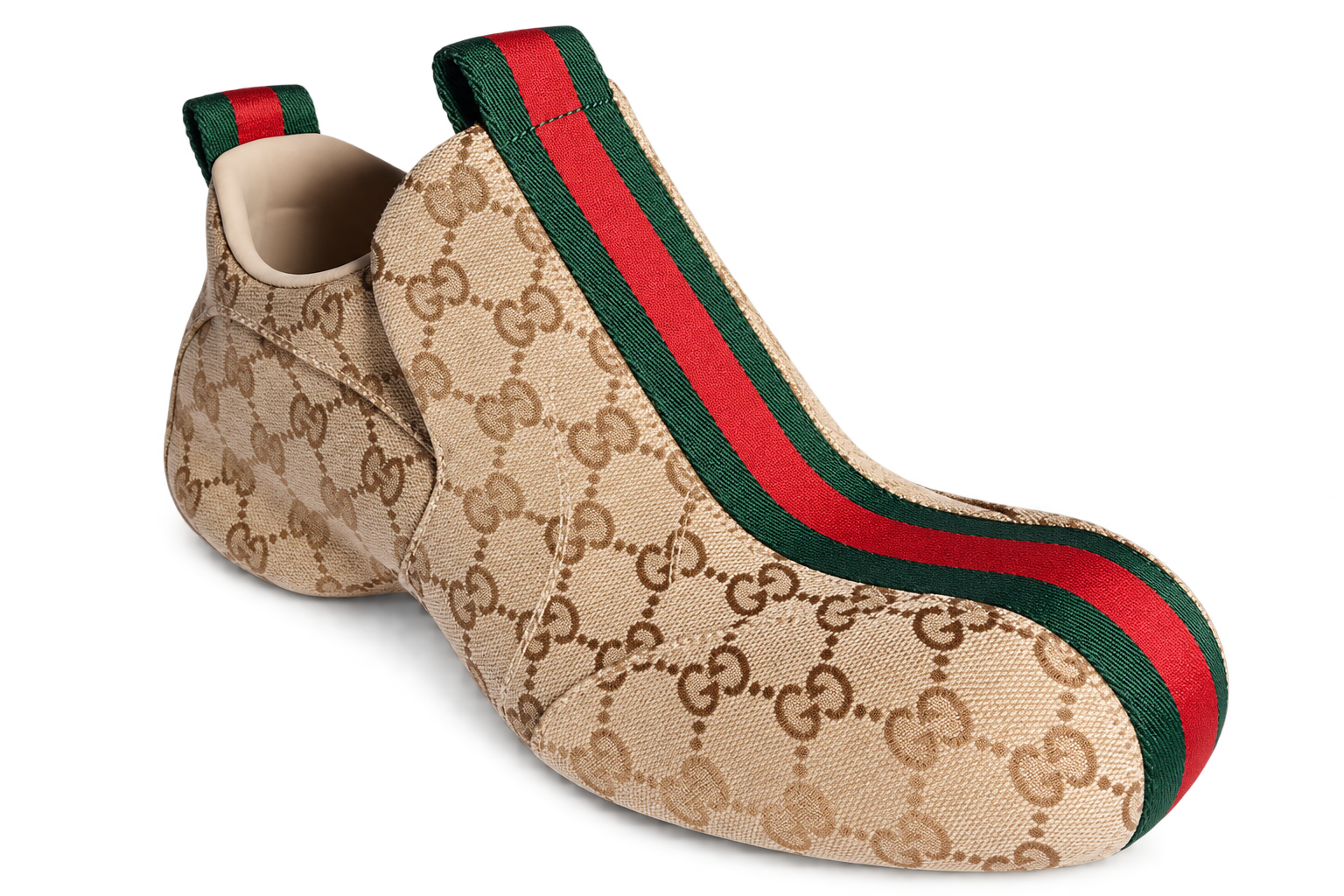
Gucci’s first sneaker under Demna is called the Drip. It costs €820, carries the house’s familiar GG canvas and is made in China.
The predictable reaction is to ask whether a Chinese-made sneaker can justify an Italian luxury price. But that question is already late.
On itsproduct page, Gucci describes the Drip as a technical sneaker inspired by climbing shoes. The housetold Reutersthat its manufacturing partner was selected for the expertise and capabilities required to meet the product’s performance and quality standards.
In other words, Gucci did not choose China despite the product’s technical ambition. It chose China because of it.
This is not a manufacturing scandal. It is a rearrangement of authority.
CHINA IS NO LONGER JUST THE FACTORY
For decades, the luxury industry relied on a comfortable division of labour. Manufacturing capability could travel, but cultural authority remained in Paris and Milan. China made things; Europe decided what those things meant.
That division is becoming harder to maintain.
Chinese manufacturers now possess technical capabilities sophisticated enough to produce an object that one of Italy’s most famous houses presents as luxury. At the same time,Bain has documentedthe growing relevance of Chinese brands combining innovation with cultural understanding and locally resonant narratives of value.
The Drip exposes the separation between two powers luxury once bundled together: the power to make and the power to define.
Gucci still owns the second. But it can no longer treat the first as culturally invisible.
China does not become Italy. What changes is that Italian origin can no longer claim an automatic monopoly on excellence.
A postcode is not a quality-control system.
THE PRICE NEEDS NEW PROOF
“Made in Italy” never described value perfectly. It compressed craftsmanship, control, heritage and cultural authority into three convenient words.
Once production moves, that shorthand stops doing the work.
This does not mean the Drip is overpriced. Public information cannot establish its manufacturing cost, durability, quality-control protocol or the particular expertise of its supplier. But that absence is precisely the strategic issue.
If Gucci’s choice was driven by capability, where is the capability made visible?
The product page currently asks the design, the logo and the authority of the house to carry most of the €820 price. That may be enough for some customers. It also leaves everyone else free to interpret “Made in China” using assumptions Gucci did not author.
The problem is not Chinese manufacturing. It is an unsupported luxury premium.
And the timing matters.Gucci’s comparable revenue declined 5 percent in the first half of 2026. When demand is under pressure, the name alone has to work harder. The logo can carry a shoe only so far.
FROM INHERITED ORIGIN TO DEMONSTRATED CAPABILITY
Gucci should not launch a defensive campaign about China. Nor does anyone need a sentimental factory film in tasteful lighting.
The house needs a selective product-proof system.
For the Drip, that means making three things legible: why this manufacturing capability was necessary, what the product’s construction actually achieves and how Gucci supports the object after purchase.
The evidence could appear through a concise product-page module, informed retail advisers and a clearer proposition around care, repair and warranty. Not maximum transparency. Minimum sufficient proof.
The distinction matters. Luxury is not purchased after an industrial audit. Overexplaining production can flatten desire and make the house appear strangely nervous about its own decisions.
But provenance was already a proof system. It simply worked through cultural shorthand.
When that shorthand weakens, mystery does not automatically replace it. Sometimes there is just a gap where the reason for the price should be.
WHO GETS TO DEFINE LUXURY?
The Drip is not evidence that China has become Italy. It is evidence that technical excellence is no longer geographically obedient.
That creates an opportunity for China, whose industrial power can increasingly become cultural power. It also creates a more demanding task for European houses.
If capability can come from anywhere, heritage alone cannot explain everything.
Gucci must show what transforms globally distributed expertise into something specifically Gucci — and why that transformation is worth €820.
The future of luxury may not belong to the country that makes the object, or even to the country whose name is printed inside it.
It will belong to whoever can make value believable.
PARESSE by Doria A.