The Givenchy Trap: When the Product Wins the Show and Loses the Order
A runway winner can still be a wholesale loser.
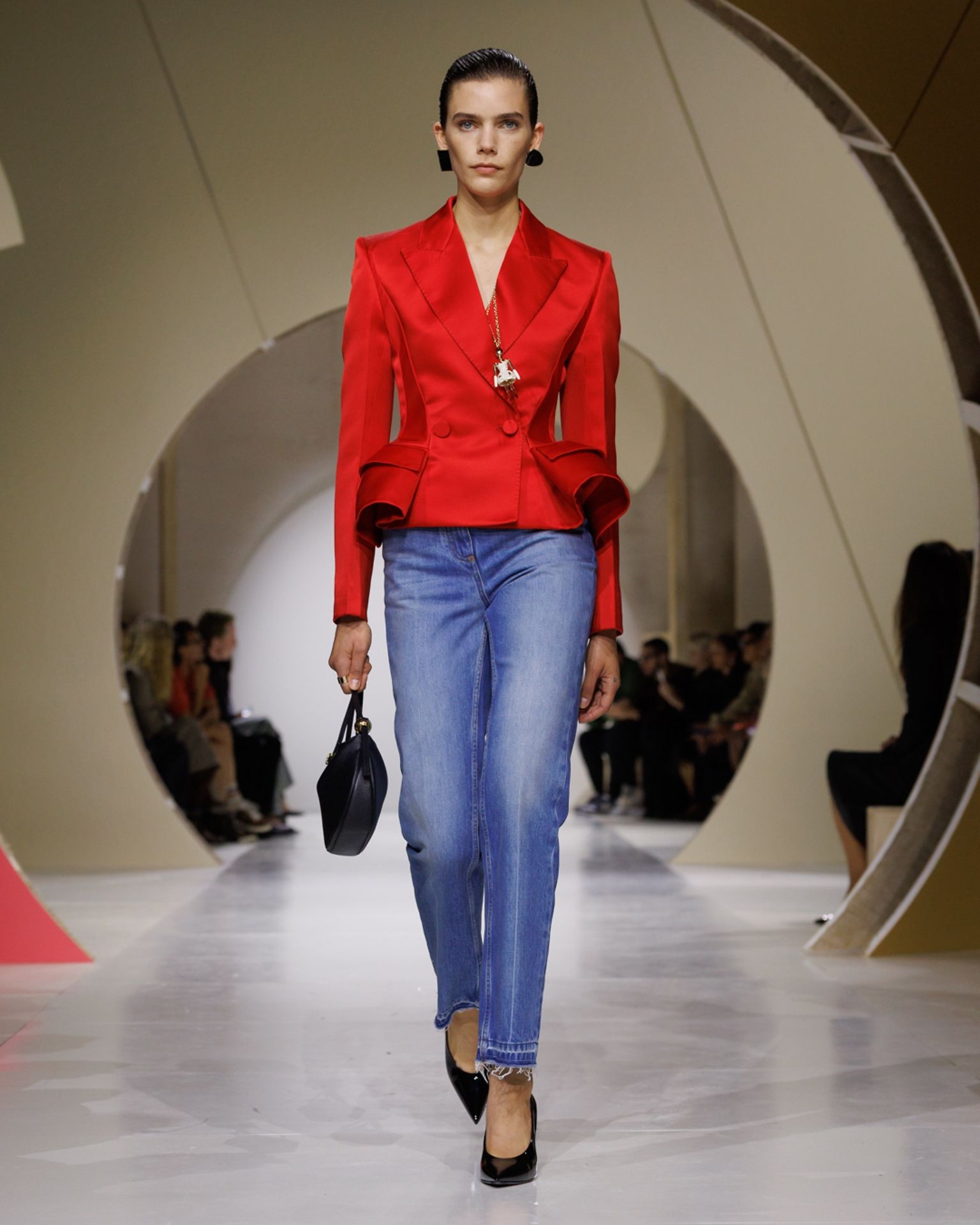
After Paris Fashion Week, Kirna Zabête founder Beth Buccini named Givenchy’s red satin peplum jacket among her favourite pieces of the season. Then came the less romantic part: at a reported retail price of $6,900, she expects the price to limit how deeply she can buy it.
This is not evidence that clients suddenly want beige clothes, smaller ideas or fewer feathers. Buyers from Harrods and Bloomingdale’s toldGlossythey were backing colour, embellishment and pieces with an immediately legible point of view. Their resistance was not to expression.
It was to paying for expression whose value had become difficult to explain.
That distinction matters.
The price is not the only signal
Givenchy’s Spring–Summer 2027 collection, designed by Sarah Burton, was built around precision, engineered cut and a wardrobe capable of moving between different versions of a woman’s life. The red jacket appears to contain that proposition in one object: memorable silhouette, sharp construction, instant image.
But a new creative language does not become a house code because it photographs well once. It becomes a code by circulating — through buyers, wardrobes, cities, repetition and recognition.
At $6,900, the jacket may function perfectly as a halo piece. It may never have been expected to sell at scale. Public information does not reveal its wholesale price, margin, production volume, construction cost or commercial target.
What the buyer’s reaction does reveal is a strategic tension: the product creates desire, while its price restricts the number of people and stores through which that desire can become culture.
The risk is not simply lower revenue. It is a collection that wins attention without acquiring social life.
Three ways out of the trap
Givenchy could keep the jacket exactly where it is: scarce, expensive and uncompromised. The benefit is creative authority. The risk is that Burton’s strongest new codes remain editorial events rather than a recognisable wardrobe.
This option only works if more accessible products carry the same idea without looking like consolation prizes.
The house could lower the price. That might increase order depth, but it is the weakest response on its own. A blunt reduction could damage margin, confuse positioning and imply that the original price was arbitrary.
It would require evidence that price — rather than fit, occasion, material or silhouette — is the principal barrier.
Or Givenchy could build a deliberate translation. Preserve the halo jacket, then isolate what makes it Givenchy: the peplum architecture, the engineered line, the red satin, the collision of ceremony and denim.
Translate one or two of those codes into a second product with a different construction and price logic — not a cheaper copy.
This is the stronger option because it protects the runway’s authority while giving the new language somewhere to live.
Do not discount the idea. Distribute it.
The recommendation is a controlled two-level product architecture, tested before the collection is fully committed.
Keep the original jacket as the image and craft proposition. Develop one exacting daywear translation for selected wholesale partners and direct retail. Show both to a small panel of buyers and clients without revealing which is expected to be the commercial winner.
Then measure more than orders.
For product, compare reactions to silhouette, material and wearability separately. For price, test whether willingness to pay moves when construction and service are made visible. For distribution, compare flagship demand with order depth from a few strategically different retailers.
For image, track whether the translated piece is recognised as part of Burton’s Givenchy rather than as diluted runway merchandise.
The useful indicators are full-price sell-through, reorders, alteration requests, returns, first-time Givenchy clients and the proportion of buyers who can explain the value difference between the two products.
If the cheaper translation sells but nobody connects it to the creative proposition, the experiment has failed culturally even if it succeeds commercially.
There is a strong counterargument: fashion needs objects that are not designed for reach. A $6,900 jacket can justify itself by setting the temperature of the collection, dressing a few exceptional clients and making every product around it feel more significant.
True. But then the house must be precise about the assignment. A halo piece should not be judged for failing to scale. And a new house code should not be left with no vehicle beyond the halo.
The problem is not that Givenchy made an expensive jacket.
The problem would be mistaking visibility for circulation.
Established facts:the Givenchy Spring–Summer 2027 collection was presented in Paris in early October; Beth Buccini praised the red satin jacket while saying its reported $6,900 price would constrain sales; other luxury buyers interviewed after fashion month continued to favour colour, ornamentation and distinctive product.
Unknowns:wholesale economics, production volume, construction cost, margin, client demand and Givenchy’s intended role for the jacket.
Sources:Givenchy Pressroom — Spring–Summer 2027;FHCM — Givenchy Spring–Summer 2027;Glossy — luxury shoppers question rising prices;Reuters — US luxury spending slowed in September.