Martine Rose Inherits a Shop Floor
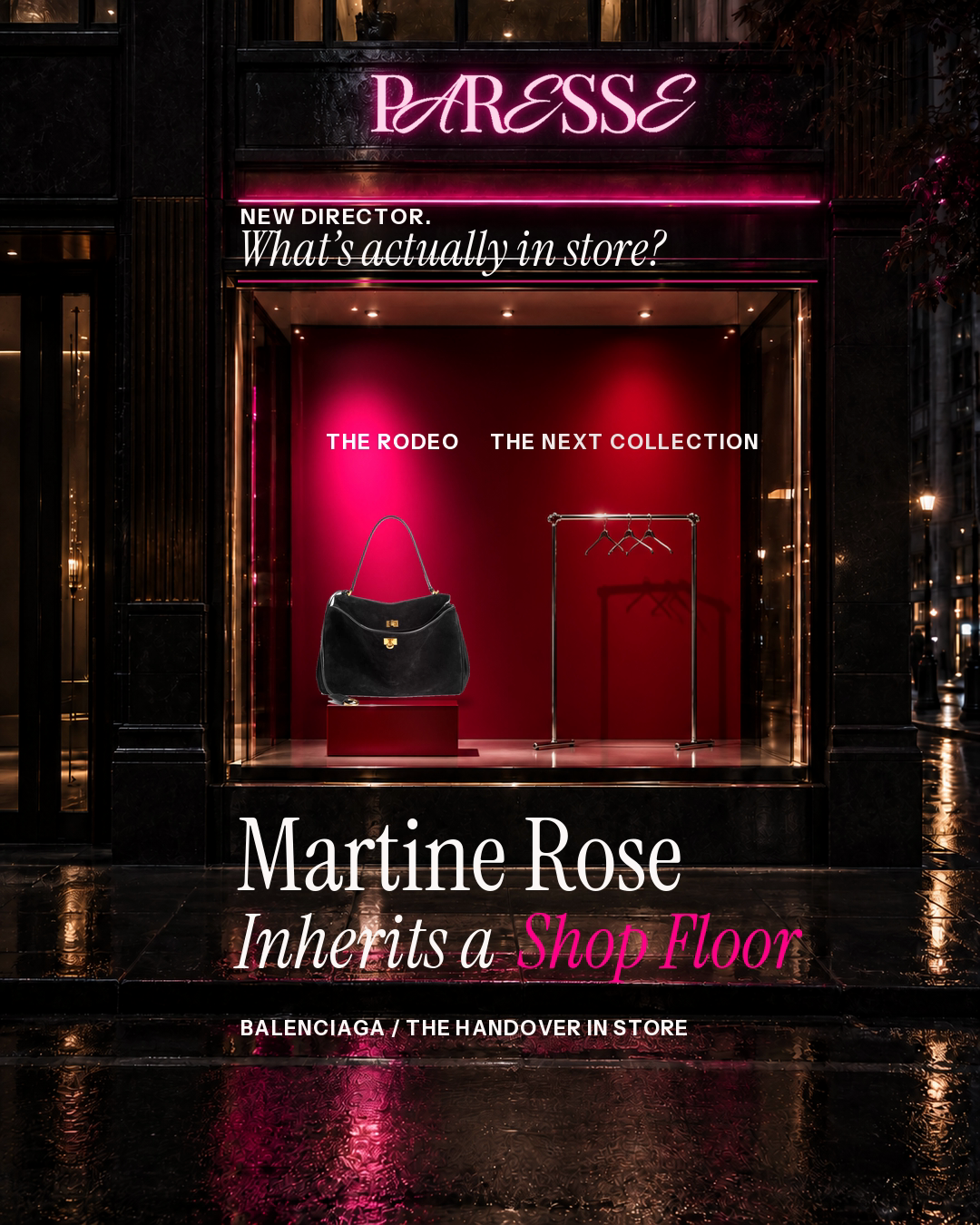
Balenciaga has a new creative director. The stockroom is still working through the previous season.
Balenciaga’s Rodeo bag has already worked for two creative directors. In July 2024, it was photographed with Isabelle Huppert, Kim Kardashian and Naomi Watts. By May 2026, it was back in a campaign under Pierpaolo Piccioli. The bag seems to take changes in management rather well.
Balenciaga’s 2024 Characters campaign · Balenciaga’s May 2026 Icon Photocards campaign
On 5 November 2026, Balenciaga announced Piccioli’s departure. He had started in July 2025 and shown his first collection that October. The following day, Kering named Martine Rose as his successor, effective 16 November.
The dates are precise. The commercial picture is less tidy. In October, Kering described Balenciaga’s leather goods as resilient and reported continued difficulties in ready-to-wear and shoes. That gives the incoming team a reason to treat the categories differently. It gives the rest of us very little to go on about how any particular collection performed.
Balenciaga’s house chronology · Departure announcement · Rose’s appointment · Kering’s October trading update
What actually changes hands
Piccioli’s Summer 2027 collection applied couture techniques to everyday pieces, including jeans and bombers. Rose has made a career out of taking familiar menswear and changing how it sits on the body and who it seems to belong to.
For Rose and Balenciaga CEO Gianfranco Gianangeli, there’s a practical decision inside that change of taste. Which pieces should the house keep making, and how much room can it give the studio to develop what comes next?
Balenciaga’s Summer 2027 collection notes · Kering on Rose’s appointment and practice
The handover can fool you in two ways. First, a new window can sell an old bag, and a new jacket can look like a slow seller when its most requested sizes turn up three weeks late. Give both sales to whoever happens to be creative director that quarter and you’ve produced a very neat spreadsheet about the wrong thing.
Then there’s the question of who gets the next fitting. You can keep every pattern in the archive and still lose the ability to use what the atelier learned.
If the pattern cutters and sample rooms are booked finishing the outgoing range, Rose can have a show date and very little time to change what reaches the rail. Reserve that time before the inherited calendar fills it.
How much of a reset?
Balenciaga could reset the range with Rose’s first delivery. The stores and wholesale buyers would get a coherent proposition quickly.
That only works if the new stock is ready in sufficient depth, buyers can adjust their commitments and the house can afford to clear what it has already ordered. Otherwise, the outlet gets the most decisive edit.
It could also let Rose lead the runway while stores keep the existing buy for another season. That buys development time and protects deliveries, provided the new studio has its own budget and production slots.
The longer the split lasts, the more often a sales adviser has to explain why the clothes in the campaign are somewhere else.
I’d change the range by category. Keep replenishing the leather goods that earn their space at full price, honour viable wholesale orders and give Rose enough atelier time and buying budget to make one new ready-to-wear proposition properly. I’d start with tailoring, if she sees a silhouette worth backing.
Put the whole look in the window of a few stores, with enough jackets and trousers in the sizes people actually ask for. The rollout will be uneven for a season.
In exchange, the house gets to find out what customers will buy before asking every store to bet on it.
Start the clock when it’s in stock
Compare the pilot with similar stores carrying the existing offer at comparable prices. Count selling weeks from when the core sizes are available.
Once returns have come back, look at full-price sales, reorders and what the category earned after markdowns and the extra development costs. Check what happened to the pieces the new range displaced.
A sellout on a tiny buy is a good afternoon. It takes a reorder to learn a little more.
There’s a case for moving faster. Rose’s proportions may need a whole room to make sense, and carrying yesterday’s range can tie up money the studio needs today.
If stock is ageing, orders are weakening and the new collection is ready to ship, a broader reset could be the better decision. The public figures can’t settle that.
I’d start with a window that makes the new idea visible and a rail that lets someone take it home.